Does Your Google Business Profile Actually Bring In Customers? The Research Says Yes.
If you run a local business, you’ve probably heard that you need to “optimize your Google Business Profile.”
But does it actually make a difference? Or is it just another thing marketers say to sell you something?
We went looking for real evidence — peer-reviewed studies, large-scale data analyses, and Google’s own research — to find out what actually happens when local businesses show up higher on Google Maps and keep their profiles in good shape.
The short answer: yes, it matters. Here’s why, backed by the numbers.
Showing Up in the Top 3 Results Changes Everything
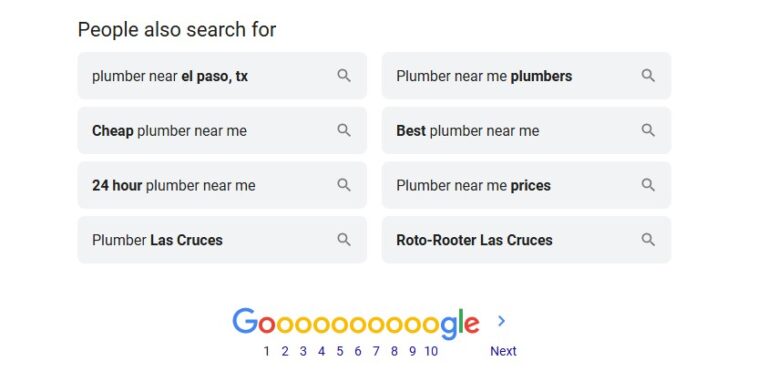
When someone searches for a service near them — “dentist near me,” “CPA in Las Cruces,” “best chiropractor” — Google shows a map with three businesses listed underneath it. That’s called the Local Pack, or the “3-pack.”
Getting into those top three spots isn’t just a vanity metric. A large-scale analysis by SOCi, covering 12.9 billion data points across hundreds of multi-location brands, found that businesses appearing in the 3-pack received 126% more traffic and 93% more customer actions (calls, website clicks, and direction requests) compared to businesses ranked in positions 4 through 10.1
Think about that: the businesses just below the top three got roughly half the engagement. If you’re not visible in the 3-pack for the searches that matter to your business, you’re likely losing potential customers to competitors who are.
Click-through rate data from First Page Sage supports this pattern, estimating that the #1 local pack position captures about 17.6% of clicks, #2 gets 15.4%, and #3 gets 15.1%.2 A controlled click-test study by iLawyerMarketing (with over 1,000 participants) found that the local pack as a whole attracted 29% of all first clicks for a high-intent local search.3
A Complete Profile Gets Dramatically More Engagement
You might think the content of your profile doesn’t matter much — people just want a phone number, right? The data tells a different story.
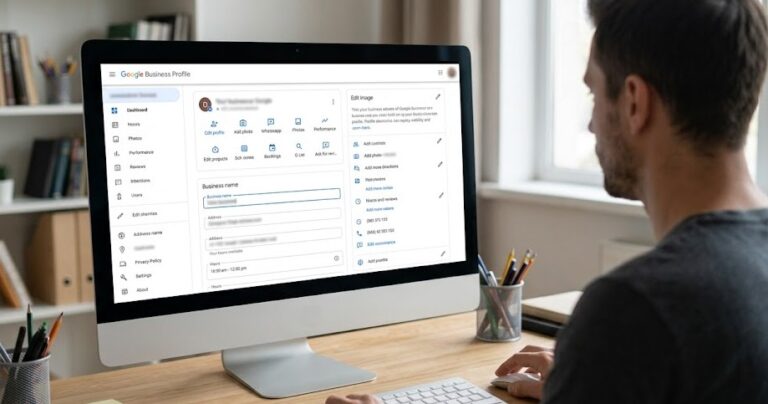
According to Google’s own benchmarks, businesses with complete and accurate profiles receive 7 times more clicks than businesses with incomplete listings. Profiles that are regularly updated get 5 times more views. And businesses that include photos see 42% more direction requests and 35% more website clicks than those without.4
These are big numbers. Even if you discount them somewhat (Google hasn’t published detailed methodology behind these figures), the direction is clear: a bare-bones profile is leaving money on the table.
Independent research backs this up. BrightLocal analyzed over 45,000 Google Business Profiles across 36 industries in the U.S., Canada, Australia, and the U.K. They found that only about 5% of profile views result in a customer action (a call, a click, or a direction request) — which means the quality of your listing directly affects whether someone who sees you actually reaches out.5
Their data on photos was especially striking: businesses with more than 100 images showed dramatically higher engagement across the board — more calls, more direction requests, more website clicks. Now, 100 photos isn’t realistic for every business, and the researchers themselves cautioned that these businesses may simply be more sophisticated marketers overall. But the takeaway holds: visual content on your profile matters more than most business owners realize.5
Your Star Rating Directly Affects Your Revenue
This is where the research gets especially interesting — and rigorous.
A widely cited Harvard Business School study by Michael Luca used actual tax revenue data from the Washington State Department of Revenue, combined with Yelp ratings for 3,582 restaurants. By exploiting the way Yelp rounds its star ratings (a restaurant with a 3.24 average displays as 3 stars, while a 3.26 displays as 3.5 stars), Luca was able to isolate a causal effect. The result: a one-star increase in rating led to a 5–9% increase in revenue for independent restaurants. Chain restaurants saw no significant effect — consumers already know what to expect from a chain, so reviews matter less.6
A complementary study by UC Berkeley economists Michael Anderson and Jeremy Magruder, published in The Economic Journal, used the same rounding-threshold approach with Yelp ratings and restaurant reservation data in San Francisco. They found that crossing a half-star threshold (say, going from 3 stars to 3.5) increased the probability of being sold out at peak times by about 19 percentage points.7
And in the hotel industry, researchers Gregory Lewis and Georgios Zervas tracked nearly 6,000 hotels over a decade using financial performance data and millions of review ratings across TripAdvisor, Expedia, and Hotels.com. By 2014, they found that a hotel rated one star higher across review platforms had roughly 25% higher demand and charged about 9% more.8
These studies aren’t about Google Business Profile specifically — they’re about online reviews and ratings in general. But the principle applies directly: your star rating on Google is one of the most visible signals potential customers see, and it measurably influences whether they choose you.
Local Searches Lead to Fast Action
One thing that makes Google Business Profile optimization different from, say, running a billboard is the intent behind it. People searching locally are often ready to act.
Google partnered with research firm Ipsos to study this behavior among U.S. smartphone users. They found that 50% of people who conducted a local search on their phone visited a store within one day, and 18% of those local searches led to a purchase the same day — compared to just 7% for non-local searches.9
A separate Google/Purchased digital diary study reported even higher numbers: 76% of people who searched for something nearby visited a business within a day, and 28% made a purchase.10
The implication is straightforward. When someone finds your business through a local search, there’s a strong chance they’re going to show up or call — often that same day. Making sure they can find you, and that your listing gives them the confidence to choose you, isn’t a nice-to-have. It’s the last step before they walk through your door.
What This Means for Your Business
The research doesn’t support the idea that Google Business Profile optimization is a magic growth lever. No single study says “do X to your listing and revenue goes up by Y%.” The real world is messier than that. But three things are well-supported by evidence:
Visibility drives action.
Businesses that appear in the top local results get significantly more calls, clicks, and direction requests. The gap between being in the 3-pack and being buried below it is substantial.
Profile quality affects conversion.
Complete information, accurate hours, quality photos, and regular updates are consistently associated with higher engagement — across Google’s own data and large independent studies.
Reviews and ratings affect revenue.
This is the most rigorously tested finding in the bunch. Multiple peer-reviewed studies using causal research designs show that higher ratings translate to more customers and more revenue, especially for independent local businesses where customers don’t already have strong expectations.
The most practical way to think about it: Google Business Profile optimization won’t replace a great service, competitive pricing, or word-of-mouth reputation. But it makes sure that when someone is actively searching for what you offer — ready to call, ready to visit, ready to buy — they find you instead of someone else.
Sources
1. SOCi, “2022 Local Marketing Benchmark Report,” based on analysis of 12.9 billion data points across 291 multi-location brands.
2. First Page Sage, “Google Click-Through Rates (CTR) by Position,” 2025. Meta-analysis combining multiple sources and internal data.
3. iLawyerMarketing, “Click Test Study: LSA Ads, Local Pack or Organic Results,” 2025.
4. Google, “Complete your Business Profile on Google” and related GBP best practices documentation. Statistics sourced from Google internal data.
5. BrightLocal, “Google My Business Insights Study,” 2019. Analysis of 45,264 business profiles across 36 industries in the U.S., Canada, Australia, and U.K.
6. Luca, Michael. “Reviews, Reputation, and Revenue: The Case of Yelp.com.” Harvard Business School Working Paper No. 12-016, 2011 (revised 2016).
7. Anderson, Michael L. and Jeremy Magruder. “Learning from the Crowd: Regression Discontinuity Estimates of the Effects of an Online Review Database.” The Economic Journal, Vol. 122, No. 563, pp. 957–989, 2012.
8. Lewis, Gregory and Georgios Zervas. “The Supply and Demand Effects of Review Platforms.” Proceedings of the 2019 ACM Conference on Economics and Computation, 2019. Panel of 5,944 hotels, 2005–2014.
9. Google/Ipsos MediaCT/Purchased, “Understanding Consumers’ Local Search Behavior,” May 2014. Survey of 4,500 U.S. smartphone users plus 7-day digital diary study.
10. Think with Google/Purchased, “How Mobile Search Connects Consumers to Stores,” 2016. Sample: 1,000 smartphone users, 634 local searchers.


True Ceiling Solutions helps local businesses in Las Cruces and Southern New Mexico manage and optimize their Google Business Profile as part of a complete local visibility strategy. If you’d like to see how your profile stacks up, schedule a free visibility audit by filling out the form below — we’ll show you exactly where you stand and what we’d recommend.
Let’s Talk About Your Business
Fill out the form below and our team will reach out to schedule your free visibility audit — a no-pressure conversation about where your business stands online and where it could be.