The Local Pack: What It Is, Why It Matters, and How To Get In It
If you’ve been following along in this series, you’ve seen me reference the Local Pack a few times. The Local Pack is worth its own post, not because the concept is complicated, but because most small business owners don’t fully understand what they’re competing for or how the competition actually works. Let’s review what it is and why it matters to your business.
What it is
When someone types a local service query into Google like “plumber near me,” “family dentist Las Cruces,” or “tax accountant downtown,” the first thing that appears beneath the ads is a map with three business listings. Each listing shows the business name, rating, address, phone number, hours, and links to directions or to the website. That’s what I mean by “Local Pack.”
Three spots. That’s it. For any given search, in any given location, Google selects three businesses and puts them front and center. Everyone else is beneath the fold, in the smaller organic results, or effectively invisible.
Why It Matters: The Numbers
Here’s where we want to get specific, because the numbers are stunning. According to a Moz case study, roughly 44% of local searchers click on a Local Pack result. Organic website listings below the Pack capture about 29%. Paid ads capture 19%. The remaining 8% scroll down for more local results (read more here).
In other words: the Local Pack captures nearly half of all the clicks in local search, while requiring no advertising spend to appear in it.
The gap compounds when you look at actions. A SOCi analysis of local search behavior found that businesses in the top three Local Pack positions receive 93% more calls, direction requests, and website clicks than businesses ranked in positions 4-10. Let that sink in: that means that the top 3 results in Google search for a given keyword are pulling 93% of the GBP leads.
The Local Pack is the most valuable real estate in local search, and it costs nothing but the investment of optimizing your profile correctly.
How Google Decides Who Gets In
Google has published the framework it uses to rank local results, and it comes down to three factors: relevance, distance, and prominence (source).
Relevance is how well your profile matches what the person searched for. This is primarily determined by your business category, your service listings, and the content of your profile and linked website. A plumber who has filled out every service field, written a complete business description, and has a website that clearly describes their services will rank for more relevant searches than one who claimed their listing and left it half-empty.
Distance is straightforward: how far is your business from the searcher’s location, or from the location term in their search? You can’t move your address to manipulate this. What you can do is make sure your service area is correctly defined in your profile — especially important for businesses that serve customers at their location rather than at a fixed storefront.
Prominence is where most of the controllable work happens. It’s Google’s assessment of how well-established and trusted your business is, and it’s determined by: your review count, your review recency, your rating, how often people search for your business by name, how many websites link to yours, and how consistently your business information appears across the web. This is the pillar that rewards active, well-maintained profiles over neglected ones.
One thing worth understanding: these three factors interact. A business with strong prominence can outrank a closer competitor. A highly relevant profile can appear for searches where proximity would otherwise work against it. Distance is the one factor you genuinely can’t optimize, but it’s also the one that strong relevance and prominence can partially override. (If you want to know more, you can read this insightful article about Google and Local SEO.)
What To Do This Week
Most of the work of getting into the Local Pack comes back to the same fundamentals: a complete and accurate profile, a consistent stream of recent reviews, and a website that reinforces what your profile says about you. None of that is complicated. What keeps most businesses out isn’t a lack of knowledge — it’s a lack of consistent follow-through.
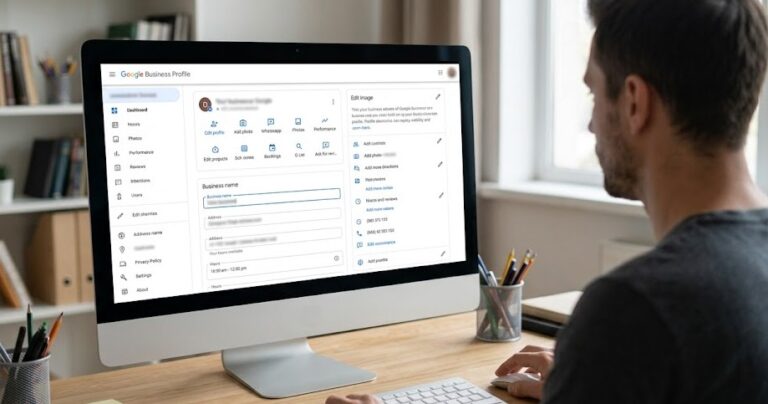
A few specific things worth auditing on your own profile this week: Is your primary business category as specific as it can be? (Whitespark’s 2026 Local Search Ranking Factors Survey identifies this as the single most influential Local Pack ranking factor.) Are all your service fields filled in? Is your business description complete? Are your hours current? When was your last review?
Each of these is a signal Google is reading when it decides who fills those three spots.
Next week, we will go deeper on the full optimization checklist including what to fill in, how to approach photos and posts, and what actually moves the needle versus what’s mostly noise. For now: if you’ve never audited your profile against these three factors, that’s the starting point.


Not sure what your Google Business Profile looks like to potential customers right now? Our Free Visibility Audit will show you exactly where your listing stands — and what it might be costing you. Fill out the form below to get started.
Let’s Talk About Your Business
Fill out the form below and our team will reach out to schedule your free visibility audit — a no-pressure conversation about where your business stands online and where it could be.