Why Your Website Is Costing You Customers Before They Even Call
If you’ve been reading this series, you know your Google Business Profile is doing significant work in local search. Your website still matters, though, and what happens when someone visits it largely determines whether they call you or go back and click the next result.
So many local business websites are losing that moment because they’ve never been evaluated from the perspective of someone who found the business on their phone and is deciding in a few seconds whether to bother.
Google is evaluating your site from a phone
Google completed its transition to mobile-first indexing in 2024 (source). That means Google uses the mobile version of your website to crawl, index, and rank your pages. It also confirmed in 2018 that page speed is a direct ranking factor for mobile searches (source).
If you built your website thinking primarily about how it looks on a desktop, you may be ranking and converting on the basis of an experience most of your visitors aren’t actually having.
Speed is the first filter
Before a visitor reads a single word on your site, they’re waiting for it to load. On a mobile connection, patience is short. A site that takes more than a few seconds to load loses visitors before the page is visible, and those visitors don’t come back.
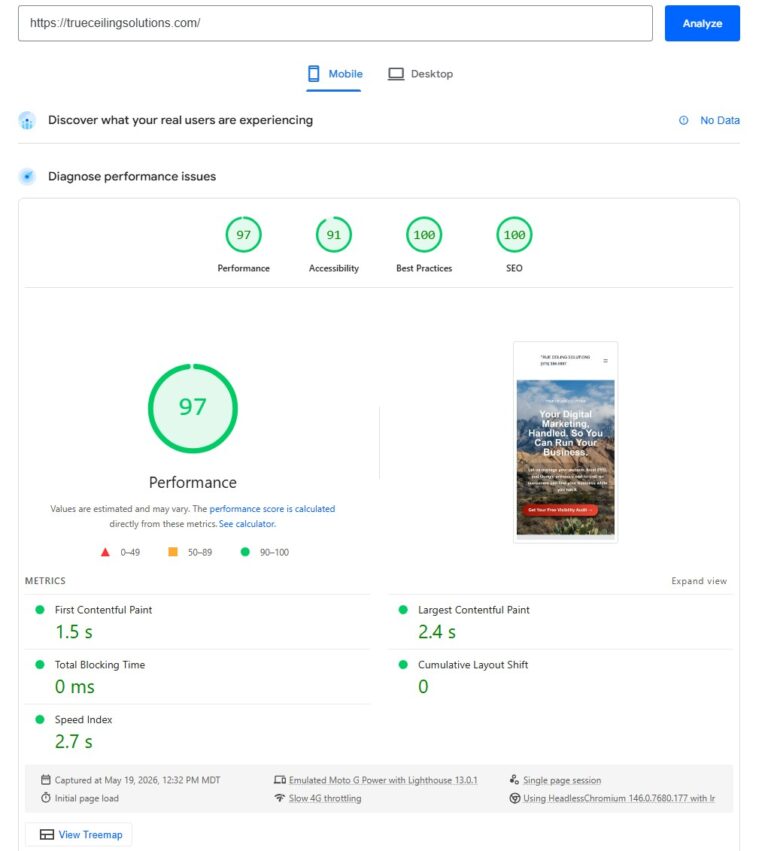
You can check where your site stands using Google’s PageSpeed Insights tool (pagespeed.web.dev). It’s free and takes about 30 seconds. It gives you a score for mobile and desktop performance separately, and it tells you specifically what’s slowing the site down. A mobile score below 50 is a concrete problem. Below 70 is meaningful room to improve.
What a local customer needs to see immediately
Assume the person who just landed on your homepage found you on their phone, they’re somewhere trying to make a quick decision, and they want to know if you’re the right business to call. They are not going to read your about page. They’re scanning for what you do, where you serve, how to reach you, and whether you seem worth trusting.
If your homepage buries the phone number, opens with a hero image that fills the screen before any text appears, or leads with a paragraph about your company’s history, you’re asking someone with high intent and low patience to do more work than they’re willing to do.
The phone number should be tappable and visible without scrolling. The service area should be clear in the first few lines. Beyond that, stating your core service plainly matters more than creative copywriting. These are functional requirements, not design preferences.
Trust signals matter more than aesthetics
A website doesn’t need to be beautiful to convert local visitors. It needs to be believable. For a local service business, that comes from real photos of the actual business or team rather than stock imagery, a service area that matches what’s on your GBP, visible reviews or a direct link to them, and contact information that’s consistent across your online presence.
A polished website with generic stock photos and no mention of your area (i.e., Las Cruces or Southern New Mexico) tells a local visitor nothing specific about you. A simpler site with a real team photo, a clear service area statement, and a Google review link gives them something to anchor a decision on.
The website and the profile work together
Your GBP handles the initial discovery moment in local search. Your website handles what comes after: the deeper evaluation, the form submission, the decision to call. A strong profile with a weak website means you’re getting the first impression right and fumbling the handoff.
If you’re not sure whether your website is helping or hurting you at that moment, that’s what our Free Visibility Audit examines. It looks at your profile, your site, and how they’re functioning together for local visitors.
What to do this week
Pull up your website on your phone, not your desktop. You’re checking four things: how long it takes to load, whether your phone number is visible and tappable without scrolling, whether your service area is stated clearly in the first screen, and whether the page gives a local visitor a reason to trust you before they’ve read more than a few lines.
Then run your URL through Google’s PageSpeed Insights (pagespeed.web.dev) and check your mobile score specifically. If it’s below 70, the tool will tell you what’s causing it. Some issues require a developer to fix; others, like oversized images, can often be resolved quickly without one.
If you find significant gaps, those are worth addressing before investing further in any other part of your marketing. A GBP that sends people to a slow, hard-to-navigate website is working against itself.


Not sure what your Google Business Profile looks like to potential customers right now? Our Free Visibility Audit will show you exactly where your listing stands — and what it might be costing you. Fill out the form below to get started.
Let’s Talk About Your Business
Fill out the form below and our team will reach out to schedule your free visibility audit — a no-pressure conversation about where your business stands online and where it could be.